How to Identify English Elm, Wych Elm and Smooth-leaved Elm: A Beginner's Guide
Learn how to tell English elm, Wych elm and smooth-leaved elm apart using leaf shape and texture, bark, twigs and samaras. A practical UK field guide for beginners.
Elms have a reputation for being difficult. That is partly deserved. Dutch elm disease removed most of our mature elms, and what regrew is often a thicket of suckers rather than a stately tree. Add hybrids and local microspecies, and identification can feel like a puzzle. But for the three main native elms in the UK — English elm, Wych elm and smooth-leaved elm — there are reliable features in the leaves, bark and seeds. You do not need to be a botanist. You need to look closely, check more than one part of the tree, and resist the urge to decide from a single leaf.
Why elm identification is harder than it looks
Start with the caveat. Many elms in Britain are hybrids, and some are named microspecies that even experts debate. English elm itself is often treated as a single clone, which is why it suckers so freely. Dutch elm disease means you are often looking at young regrowth from a stump or root system, not a full-grown tree. That affects bark and form. For a beginner, the practical approach is to learn the three main species and accept that some trees will remain “probably” rather than “certainly”.
Leaves: the first and best clue
Leaves are your best starting point from late spring to early autumn. All three species have alternate leaves with toothed edges and an asymmetric base — one side of the leaf base is lower than the other. The differences are in size, shape, texture and hairiness. Pick a leaf from a sunny, average part of the tree, not a shaded shoot or a vigorous sucker, which can be larger and less typical.
English elm (Ulmus procera)
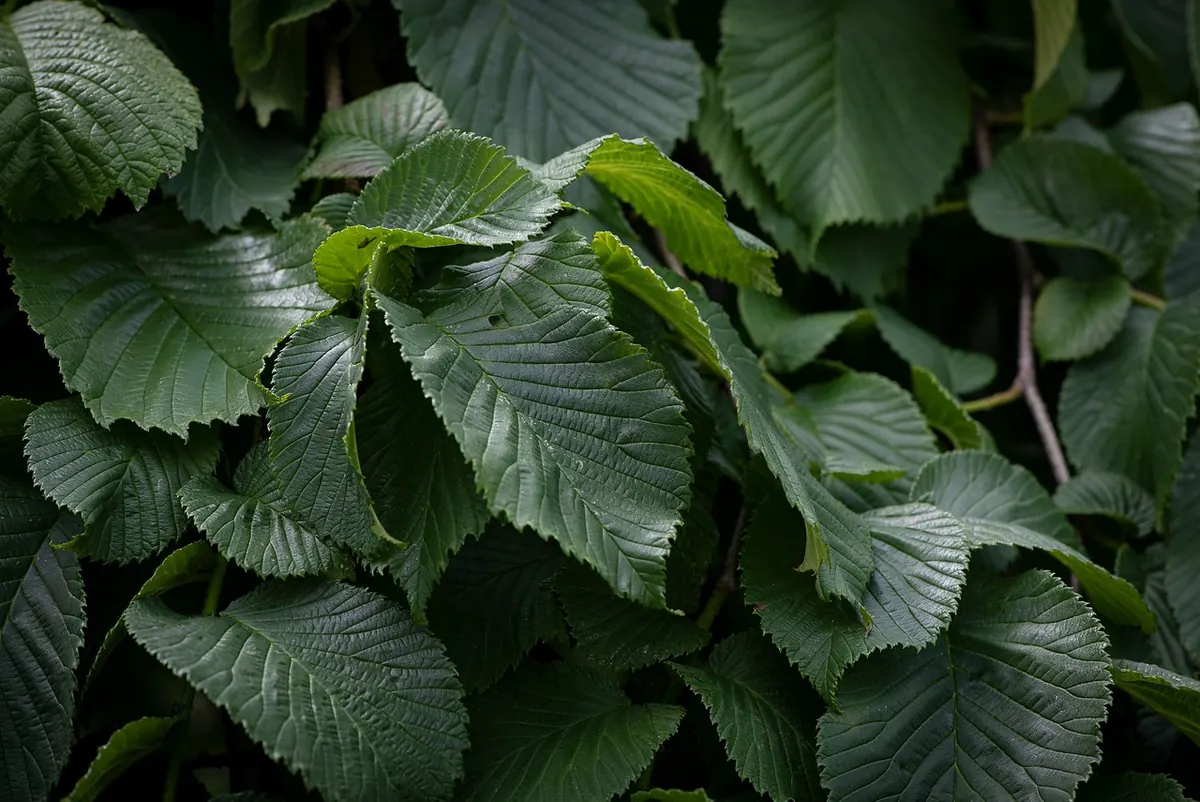
English elm leaves are usually 6–10 cm long. They are oval to roundish, with a slightly pointed tip. The upper surface is dark green and rough, like fine sandpaper, because of short stiff hairs. The underside is paler and softly hairy, at least on the veins. The base is strongly asymmetric. The edges are doubly serrated, meaning the teeth have smaller teeth on them. If you rub a leaf between your fingers, it feels distinctly rough.
Wych elm (Ulmus glabra)
Wych elm has the largest leaves of the three, typically 10–18 cm long. They are broad and often widest towards the tip, giving a slightly club-like shape. The base is very asymmetric, and one side often overlaps the leaf stalk like a small ear. The upper surface is rough and hairy; the underside is hairy too, not just in the vein corners. The teeth are large and obvious. Wych elm leaves also tend to have a short stalk, so the blade sits close to the twig.
Smooth-leaved elm (Ulmus minor)
Smooth-leaved elm leaves are the smallest, usually 4–9 cm long. They are oval to elliptical and have a smooth, glossy upper surface — the key difference from English elm. They are not rough to the touch in the same way. The underside is mostly smooth, but you can often see tufts of pale hairs where the veins meet the midrib. The base is asymmetric, though usually less dramatically so than Wych elm. The edges are doubly serrated.
Bark and tree form
Bark is useful, but only as a supporting clue. It changes with age, soil and whether the tree is regrowth from a sucker. English elm bark is dark grey-brown and deeply fissured, often with a rugged, almost corky look. It frequently grows as a hedgerow tree and suckers freely, so you may find a line of similar trunks that are all part of one clonal patch. Wych elm bark is usually greyer and smoother when young, becoming fissured with age but rarely as deeply as English elm. It is more often a woodland or parkland tree and does not sucker as aggressively. Smooth-leaved elm bark is grey-brown and fissured, and its twigs often carry corky ridges or “wings”. Those ridges are not unique to this species, but they are a helpful hint.
Seeds and samaras: the late-spring check
Elm seeds are enclosed in papery wings called samaras. They hang in clusters and are usually obvious in late spring to early summer. Wych elm samaras are the largest, often 1.5–2.5 cm long, with a broad, rounded wing. English elm and smooth-leaved elm have smaller samaras, usually around 1–1.5 cm, with the seed sitting centrally and a notch at the top. The difference in size is often clear once you have both in your hand. Look at a cluster rather than a single seed, and note the colour: they start green and turn pale brown as they ripen.
A quick comparison
- English elm: leaves 6–10 cm, rough above, hairy beneath; dark, deeply fissured bark; small samaras; suckers freely.
- Wych elm: leaves 10–18 cm, broad, rough above and hairy beneath, very asymmetric base; grey bark, smoother when young; large samaras; less suckering.
- Smooth-leaved elm: leaves 4–9 cm, smooth and glossy above, tufts of hair in vein axils beneath; grey-brown bark, often corky ridges on twigs; small samaras; suckers freely.
When and how to check
Late spring and early summer are the best times. The leaves are fully out, and the samaras are still on the tree. Take photographs of the whole tree, the bark, a close-up of the leaf upper surface, the underside, and the seeds. A hand lens helps with the hairs and vein tufts. Check several leaves from different heights and sides of the tree. Avoid basing a record on a single specimen. If you are in a park or street, note whether the tree is planted or a sucker from a hedge. That context matters.
Practical closing: a simple field routine
Use this order to narrow things down.
- Look at leaf size. Under 10 cm? Likely English or smooth-leaved. Over 10 cm? Think Wych.
- Rub the upper surface. Rough and sandpapery? English or Wych. Smooth and glossy? Smooth-leaved.
- Turn the leaf over. Hairy all over? Wych. Tufts in the vein corners? Smooth-leaved. Softly hairy on veins? English.
- Check the base. Very unequal, with one side overlapping the stalk? Wych.
- Look for samaras. Large, 1.5–2.5 cm? Wych. Small, around 1–1.5 cm? English or smooth-leaved.
- Check the twigs. Corky ridges? Smooth-leaved is a strong possibility.
- Consider the setting. Suckering thickets in a hedgerow often point to English or smooth-leaved; a single woodland tree is more likely Wych.
If two or three features agree, you can be reasonably confident. If they conflict, record what you see and come back later in the season. Elms are variable, and that is part of their character. Learning them takes a few attempts, but the leaves and seeds will soon become familiar.
Photo: Pezibear / Pixabay